Ordering Food in Korean: 8 Restaurant Phrases from Table to Bill
Published 2026-10-07
Jeonju is famous for bibimbap, and a lot of travelers plan a whole day around eating there. The menu may be only in Korean, though, and the staff may be too busy to switch to English. You don't need much to get through a meal: one magic word, a few short sentences and the confidence to say them out loud.
Every phrase below comes with romanization (Korean written in English letters) and a short tip on how it sounds.
The 8 phrases at a glance
| # | Korean | Say it like | Meaning |
|---|---|---|---|
| 1 | 두 명이에요 | Du myeongieyo | There are two of us |
| 2 | 메뉴판 주세요 | Menyupan juseyo | The menu, please |
| 3 | 이거 주세요 | Igeo juseyo | This one, please |
| 4 | 이거 매워요? | Igeo maewoyo? | Is this spicy? |
| 5 | 안 맵게 해 주세요 | An maepge hae juseyo | Please make it not spicy |
| 6 | 반찬 더 주세요 | Banchan deo juseyo | More side dishes, please |
| 7 | 계산해 주세요 | Gyesanhae juseyo | The bill, please |
| 8 | 잘 먹었습니다 | Jal meogeotseumnida | Thank you for the meal |
The magic word: 주세요
Five of the eight phrases end in 주세요 (juseyo). It means "please give me", and it turns almost any noun into a polite request: ___ 주세요 = "___, please." Learn this one word well and you can order in nearly any restaurant, café or shop.
Sound tip: juseyo is three quick beats — ju-se-yo. The "j" is softer than in English, closer to the "j" in jeep said gently.
Getting a table
1. 두 명이에요 — Du myeongieyo — There are two of us
Staff will often greet you by holding up fingers or asking Myeot bunieyo? ("How many people?"). Answer with the number plus myeong (people): han myeong (one), du myeong (two), se myeong (three), ne myeong (four).
Sound tip: Korean has two sets of numbers. People are counted with the native ones — hana, dul, set, net — which shorten to han, du, se, ne in front of myeong.
2. 메뉴판 주세요 — Menyupan juseyo — The menu, please
Menyupan is literally "menu board". In many places the menu is on the wall, so you may not need this one — but it's handy when it isn't.
Ordering
3. 이거 주세요 — Igeo juseyo — This one, please
Point at the menu or at a picture and say this. It's the most useful sentence in any restaurant. When you know the dish's name, swap it in and add a number:
- 비빔밥 하나 주세요 — Bibimbap hana juseyo — One bibimbap, please
- 물 주세요 — Mul juseyo — Water, please
- 이거 두 개 주세요 — Igeo du gae juseyo — Two of these, please
4. 이거 매워요? — Igeo maewoyo? — Is this spicy?
A must if you're not sure how much heat you can take. A red color on the menu photo is a good hint, but not always.
5. 안 맵게 해 주세요 — An maepge hae juseyo — Please make it not spicy
Not every kitchen can change a dish, but it's always fine to ask. An in front of a word makes it negative, just like in an nawasseoyo ("didn't come out").
Sound tip: it's written maep-ge but spoken maep-kke. After a ㅂ (p) sound, the ㄱ (g) that follows comes out tense and sharp.
During the meal
6. 반찬 더 주세요 — Banchan deo juseyo — More side dishes, please
Banchan are the small side dishes — kimchi, vegetables, little salads — that come with your meal. In many restaurants refills are free, and some have a self-serve corner instead. Deo means "more", so ___ 더 주세요 works for anything: Mul deo juseyo — "More water, please."
To get a server's attention, a polite Jeogiyo! ("Excuse me!") is normal in Korea. Many tables also have a call button.
Paying and leaving
7. 계산해 주세요 — Gyesanhae juseyo — The bill, please
In many Korean restaurants you pay at the counter on your way out, so you can also just walk up and say it there. Splitting the bill? Say Ttaro gyesanhalgeyo — "We'll pay separately."
Sound tip: the "ae" in gyesanhae sounds like the "e" in bed.
8. 잘 먹었습니다 — Jal meogeotseumnida — Thank you for the meal
Literally "I ate well." Say it to the staff as you leave — it's a small sentence that gets a big smile.
Sound tip: it's spoken jal meo-geot-sseum-ni-da — the "s" after "t" comes out tense.
Bonus: say it when you love it
Our Jeonju stop in SayJet has this one too: 이런 맛은 처음이에요! (Ireon maseun cheoeumieyo!) — "I've never tasted anything like this!" The pattern 이런 ___은/는 처음이에요 ("This is my first time with ___ like this") works for views, music and kimchi alike.
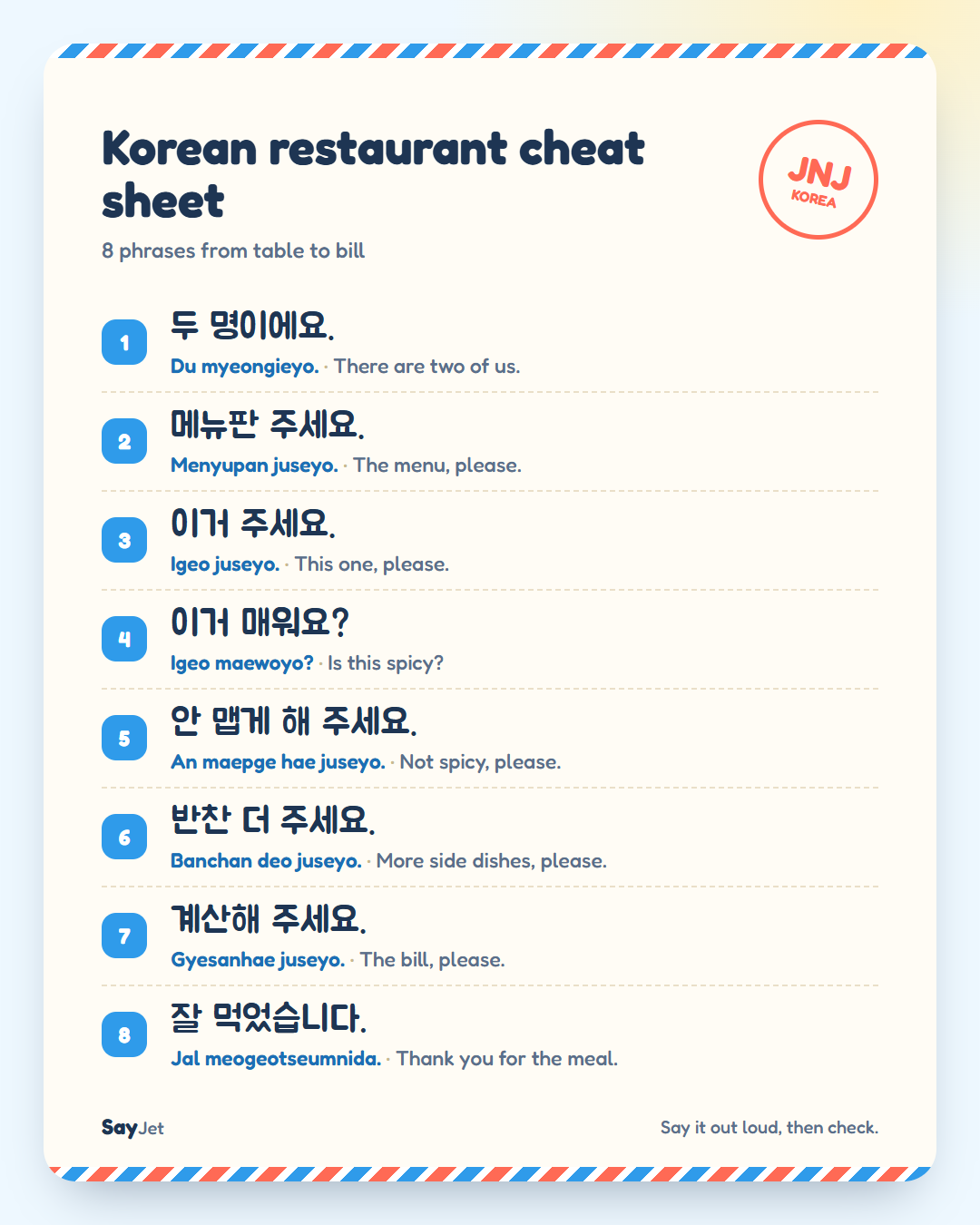
Save the cheat sheet below and say each line out loud once before you sit down.
Quick questions
Should I tip in Korean restaurants?
Tipping isn't part of Korean restaurant culture. A friendly Jal meogeotseumnida on your way out is the thank-you people expect.
Is 주세요 polite enough?
Yes. Juseyo is the standard polite form for ordering, used with staff of any age. You don't need anything fancier.
What if they answer in fast Korean?
Smile and use Igeo juseyo with a point, or ask Yeongeo haseyo? ("Do you speak English?"). Short and clear always works.
Practice them with SayJet
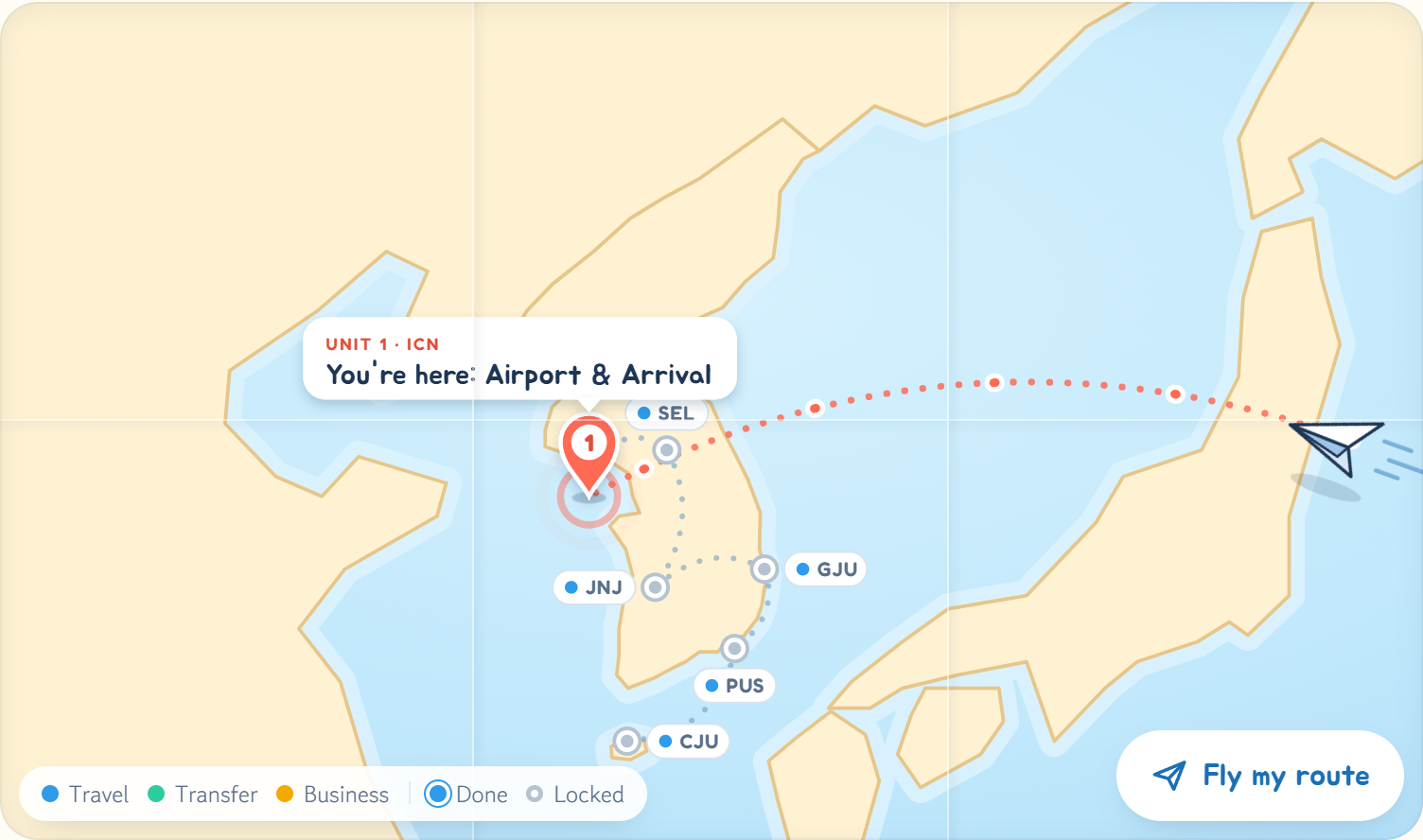
SayJet is a speaking-first app we're building. You fly a route across Korea — Incheon, Seoul, Jeonju, Gyeongju, Busan, Jeju — and each city is a set of short, real sentences you say out loud and get checked on. Jeonju is the restaurant stop. No timers, no hearts. Sign up in about 30 seconds — it's free during the beta: app.sayjet.app