Korean for Incheon Airport: 8 Phrases for Your First Hour in Korea
Published 2026-10-07
You've just landed at Incheon. Your legs are stiff, your phone has no signal, and every sign is in a script you can't read yet. The good news: your first hour in Korea runs on a surprisingly small set of sentences. Learn these eight — out loud, not just on the page — and you can greet people, find what you need, and sort out a missing bag without pointing at your phone.
Every phrase below comes with romanization (Korean written in English letters) and a short tip on how it actually sounds.
The 8 phrases at a glance
| # | Korean | Say it like | Meaning |
|---|---|---|---|
| 1 | 안녕하세요 | Annyeonghaseyo | Hello |
| 2 | 정말 감사합니다 | Jeongmal gamsahamnida | Thank you so much |
| 3 | 화장실 어디예요? | Hwajangsil eodiyeyo? | Where's the restroom? |
| 4 | 짐 찾는 곳이 어디예요? | Jim channeun gosi eodiyeyo? | Where's baggage claim? |
| 5 | 제 가방이 안 나왔어요 | Je gabangi an nawasseoyo | My bag didn't come out |
| 6 | 저는 관광객이에요 | Jeoneun gwangwanggaegieyo | I'm a tourist |
| 7 | 일주일 동안 있을 거예요 | Iljuil dongan isseul geoyeyo | I'll stay for a week |
| 8 | 유심 어디서 사요? | Yusim eodiseo sayo? | Where can I buy a SIM card? |
Step off the plane: hello and thank you
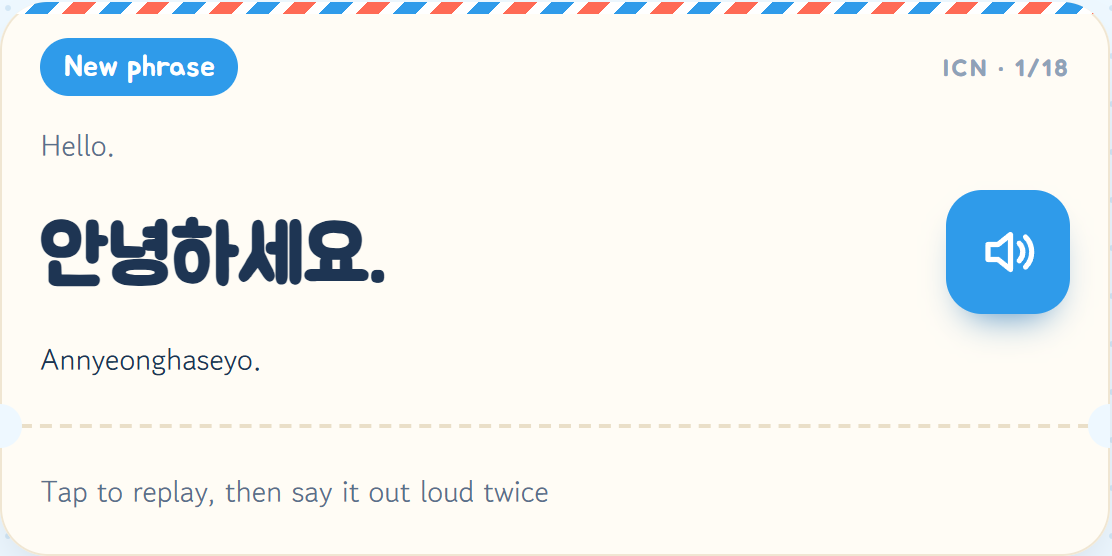
1. 안녕하세요 — Annyeonghaseyo — Hello
The one greeting you'll use all day, with everyone: flight crew, officers, taxi drivers, shop staff. It works morning, noon and night, so you don't need separate words for "good morning" or "good evening".
Sound tip: say it in five even beats — an-nyeong-ha-se-yo. A small nod while you say it feels natural in Korea.
2. 정말 감사합니다 — Jeongmal gamsahamnida — Thank you so much
Gamsahamnida on its own is "thank you". Adding jeongmal ("really") makes it warmer — perfect when someone walks you to the right gate.
Sound tip: it's written gam-sa-hap-ni-da but spoken gam-sa-ham-ni-da. When ㅂ (b/p) sits before ㄴ (n), it turns into an "m" sound.
Finding your way through the terminal
3. 화장실 어디예요? — Hwajangsil eodiyeyo? — Where's the restroom?
This is the most useful pattern on the whole list. ___ 어디예요? (___ eodiyeyo?) means "Where is ___?" Swap in any place:
- 출구 어디예요? — Chulgu eodiyeyo? — Where's the exit?
- 택시 타는 곳 어디예요? — Taeksi taneun got eodiyeyo? — Where's the taxi stand?
- 공항철도 어디예요? — Gonghang cheoldo eodiyeyo? — Where's the airport railroad (AREX)?
- 편의점 어디예요? — Pyeonuijeom eodiyeyo? — Where's a convenience store?
Sound tip: "eo" is close to the "u" in cup. Eodiyeyo sounds like "uh-dee-yeh-yo".
4. 짐 찾는 곳이 어디예요? — Jim channeun gosi eodiyeyo? — Where's baggage claim?
Same pattern, longer place name: jim (luggage) + channeun got (place where you find).
5. 제 가방이 안 나왔어요 — Je gabangi an nawasseoyo — My bag didn't come out
Hopefully you never need it. If you do, this one sentence gets you to the right desk fast. Putting an in front of a verb makes it negative: nawasseoyo (came out) → an nawasseoyo (didn't come out).
Answering simple questions
6. 저는 관광객이에요 — Jeoneun gwangwanggaegieyo — I'm a tourist
The pattern 저는 ___이에요/예요 (Jeoneun ___ ieyo/yeyo) means "I am ___". Try Jeoneun miguk saramieyo — "I'm American".
7. 일주일 동안 있을 거예요 — Iljuil dongan isseul geoyeyo — I'll stay for a week
Handy when someone asks how long you're visiting. Swap iljuil (a week) for sam-il (three days) or i-ju (two weeks).
Before you leave the airport
8. 유심 어디서 사요? — Yusim eodiseo sayo? — Where can I buy a SIM card?
Yusim comes from "USIM", so it's an easy one to remember. Eodiseo sayo? ("where do I buy?") works for anything you want to buy.
How to actually remember them
Reading a list is easy. Saying it at a busy counter is the hard part. Three habits help:
- Say every sentence out loud, not just in your head — speaking is a separate skill from reading.
- Recall before you check. Look at the English, try the Korean, then compare.
- Come back tomorrow, then in a few days. Short, spaced reviews beat one long session.
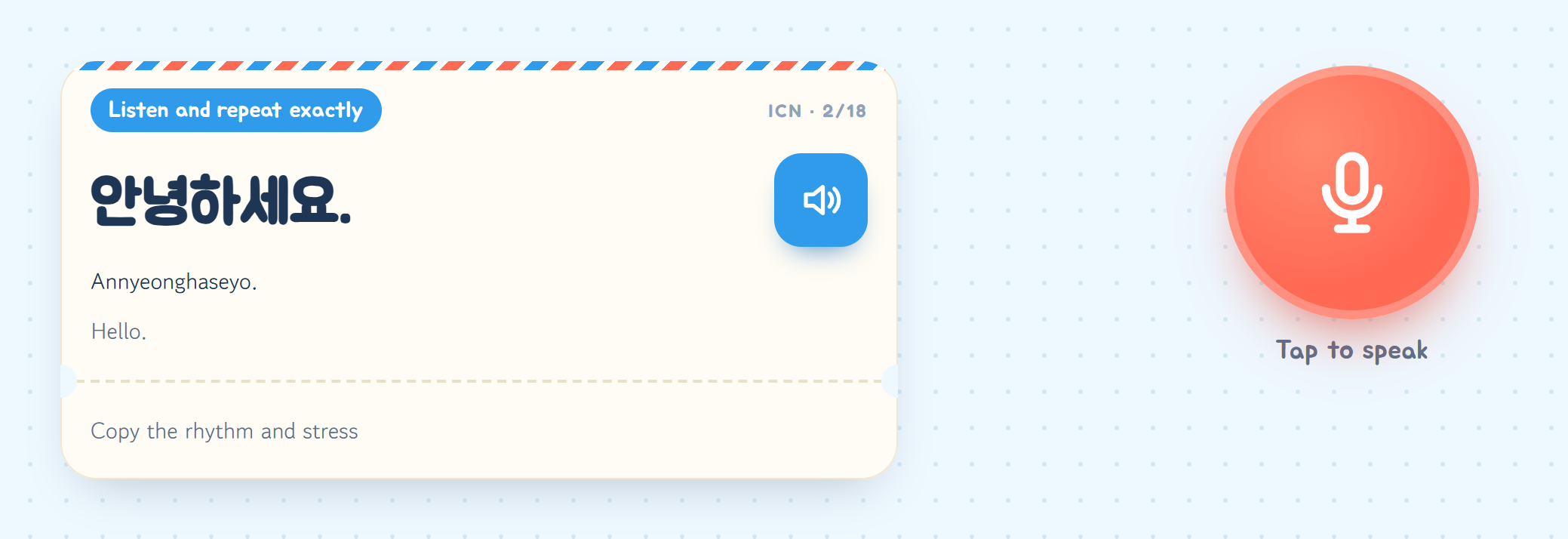
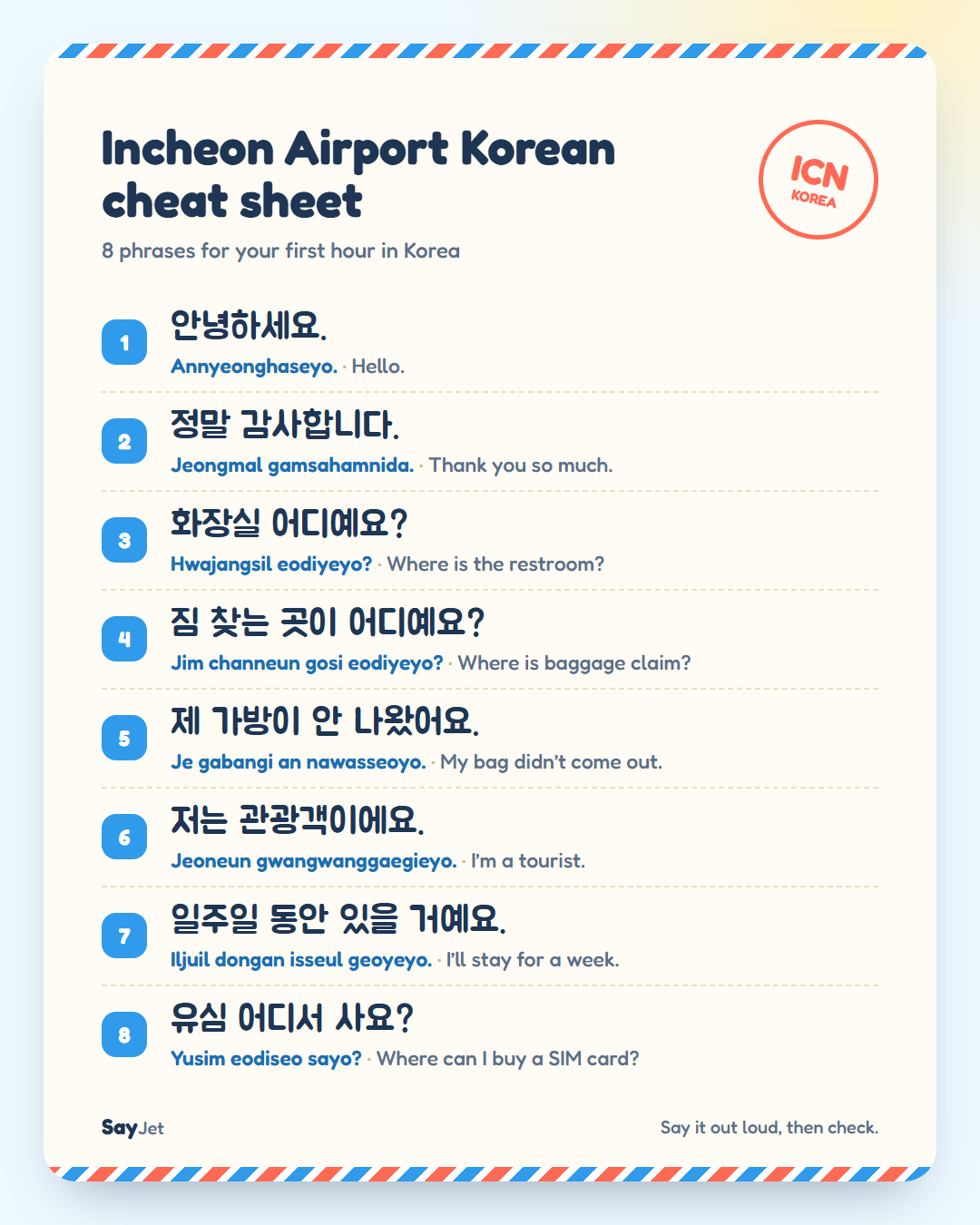
Save the cheat sheet below to your phone and run through it once on the plane.
Quick questions
Do I need to read Hangul before my trip?
No. Romanization is fine for your first phrases. That said, the Korean alphabet is famously quick to learn, and being able to sound out signs makes the airport much less confusing.
Is 안녕하세요 too formal?
It's the standard polite greeting for anyone you don't know — exactly right for travel. The short annyeong is for friends and kids.
감사합니다 or 고맙습니다?
Both mean "thank you" and both are polite. Gamsahamnida is a touch more formal and is what you'll hear most in shops and at the airport.
Practice them with SayJet
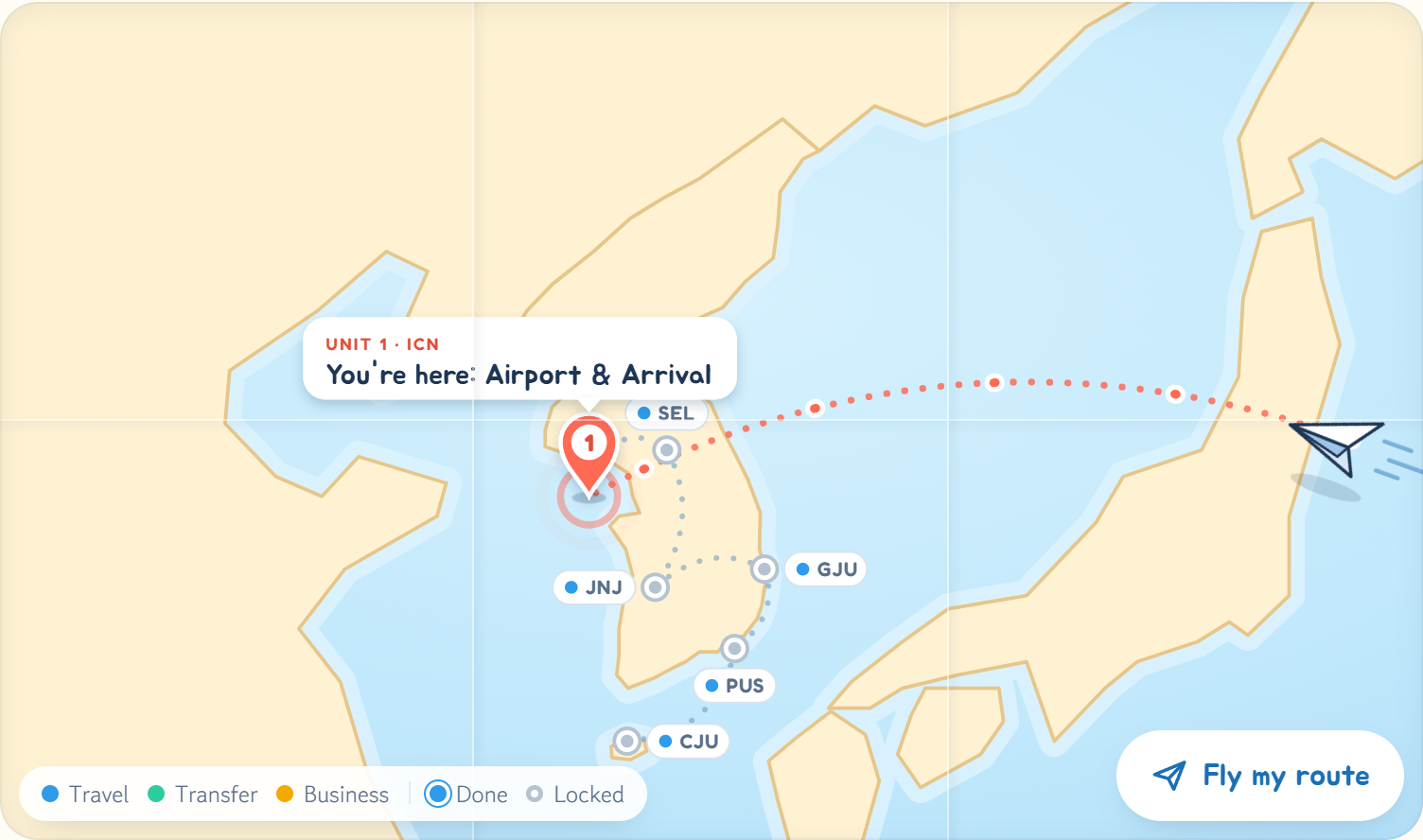
SayJet is a speaking-first app we're building. You fly a route across Korea — Incheon, Seoul, Jeonju, Gyeongju, Busan, Jeju — and each city is a set of short, real sentences you say out loud and get checked on. No timers, no hearts. Sign up in about 30 seconds — it's free during the beta: app.sayjet.app