Korean for Parents at a Korean School: 8 Phrases from the Teacher Meeting to Sports Day
Published 2026-11-10
If your child goes to a local school in Korea, you'll meet two words early on: 담임 선생님 (damim seonsaengnim), the homeroom teacher who looks after your child's class all year, and 운동회 (undonghoe), the school sports day. Many schools hold parent-teacher meetings in spring and again in the fall, and sports day often comes in the fall, and the notices, the phone calls and the small talk at the school gate usually happen in Korean.
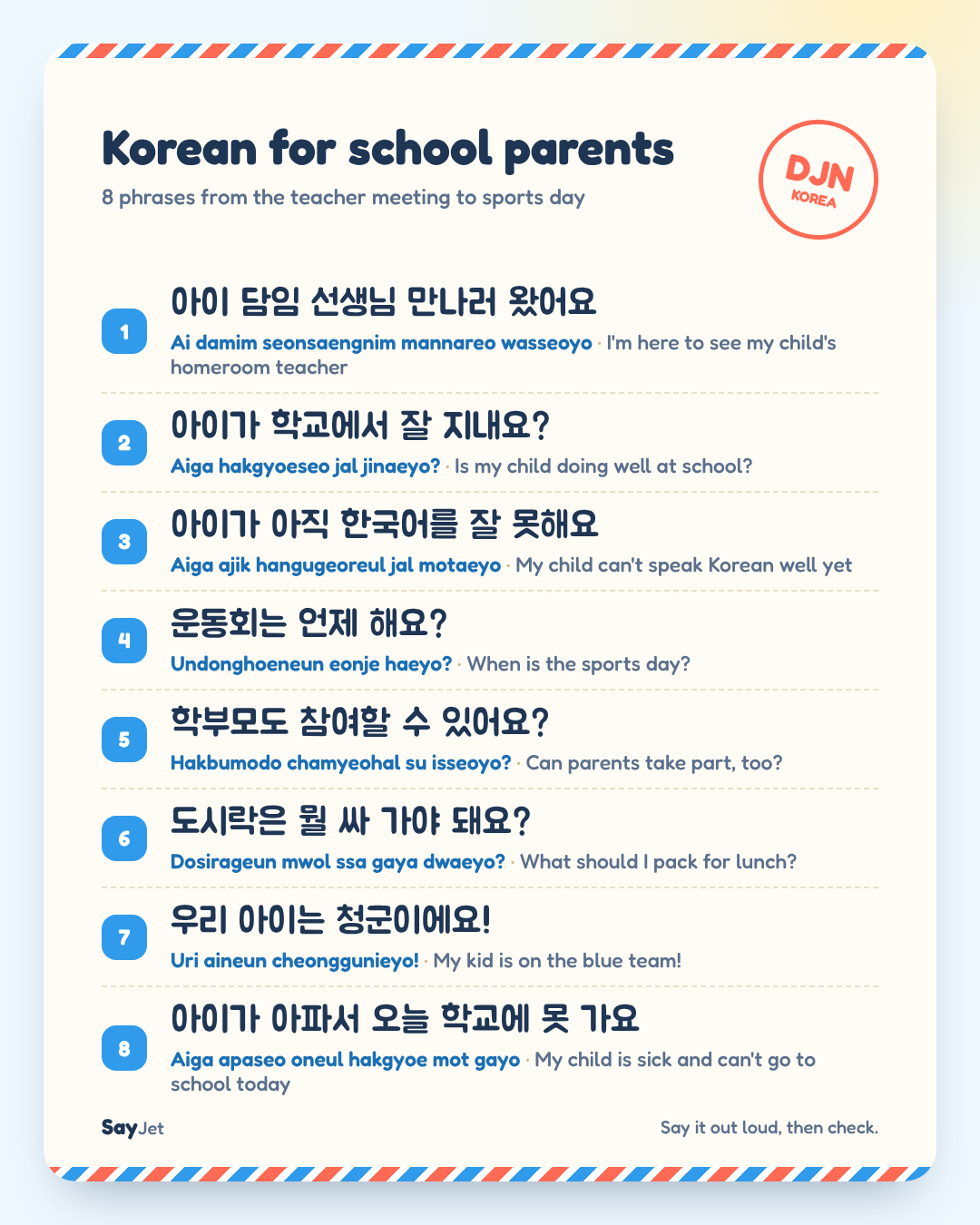
Here are eight short sentences for a parent's fall at a Korean school, with romanization (Korean written in English letters) and a tip on how each one sounds.
The 8 phrases at a glance
| # | Korean | Say it like | Meaning |
|---|---|---|---|
| 1 | 아이 담임 선생님 만나러 왔어요 | Ai damim seonsaengnim mannareo wasseoyo | I'm here to see my child's homeroom teacher |
| 2 | 아이가 학교에서 잘 지내요? | Aiga hakgyoeseo jal jinaeyo? | Is my child doing well at school? |
| 3 | 아이가 아직 한국어를 잘 못해요 | Aiga ajik hangugeoreul jal motaeyo | My child can't speak Korean well yet |
| 4 | 운동회는 언제 해요? | Undonghoeneun eonje haeyo? | When is the sports day? |
| 5 | 학부모도 참여할 수 있어요? | Hakbumodo chamyeohal su isseoyo? | Can parents take part, too? |
| 6 | 도시락은 뭘 싸 가야 돼요? | Dosirageun mwol ssa gaya dwaeyo? | What should I pack for lunch? |
| 7 | 우리 아이는 청군이에요! | Uri aineun cheonggunieyo! | My kid is on the blue team! |
| 8 | 아이가 아파서 오늘 학교에 못 가요 | Aiga apaseo oneul hakgyoe mot gayo | My child is sick and can't go to school today |
At the parent-teacher meeting
1. 아이 담임 선생님 만나러 왔어요 — Ai damim seonsaengnim mannareo wasseoyo — I'm here to see my child's homeroom teacher
Say this at the school office or the classroom door. ___(으)러 왔어요 means "I came to ___," and it works for any errand: 서류 내러 왔어요 (Seoryu naereo wasseoyo) — "I came to hand in a form."
Sound tip: 선생님 is spoken seon-saeng-nim. Keep the "n" of 선 and the "ng" of 생 apart: the tip of your tongue touches behind your teeth for "n," but stays down for "ng."
2. 아이가 학교에서 잘 지내요? — Aiga hakgyoeseo jal jinaeyo? — Is my child doing well at school?
잘 지내요? is the everyday "How are you doing?" Put 아이가 in front and it becomes the question every parent wants answered.
Sound tip: 학교 is spoken hak-kkyo. After the ㄱ at the end of 학, the next ㄱ turns tense: a hard "kk" with no puff of air.
3. 아이가 아직 한국어를 잘 못해요 — Aiga ajik hangugeoreul jal motaeyo — My child can't speak Korean well yet
잘 못해요 means "can't do it well." Teachers hear this a lot from new families, and it opens the door to a helpful talk — some schools offer extra Korean classes for students who are still learning — ask the teacher.
Sound tip: 못해요 is spoken mo-tae-yo. The ㅅ at the end of 못 is said like a "t," and it merges with the ㅎ (h) after it into one strong "t" with a puff of air.
4. 운동회는 언제 해요? — Undonghoeneun eonje haeyo? — When is the sports day?
Korean often uses 하다 (to do) for events: 운동회를 해요 — "they hold sports day." The same works for a festival or a sale: 축제는 언제 해요? (Chukjeneun eonje haeyo?) — "When is the festival?"
Sound tip: 언제 is spoken eon-je. The 어 (eo) is an open sound with relaxed, unrounded lips, close to the "u" in up — not "oh."
Getting ready for sports day
5. 학부모도 참여할 수 있어요? — Hakbumodo chamyeohal su isseoyo? — Can parents take part, too?
학부모 (hakbumo) is the word schools use for parents. At some sports days, parents run a relay or join the tug-of-war. ___(으)ㄹ 수 있어요? asks "Can I/we ___?"
Sound tip: 참여 is spoken cha-myeo. The "m" at the end of 참 slides into the next syllable, so it sounds like one smooth word.
6. 도시락은 뭘 싸 가야 돼요? — Dosirageun mwol ssa gaya dwaeyo? — What should I pack for lunch?
도시락 (dosirak) is a packed lunch, and you 싸다 (ssada, to wrap) one. Don't mix it up with the other 싸다, "cheap" — context tells you which one is meant. Korean schools serve lunch (급식, geupsik) on regular school days, so a packed lunch is usually only for field trips or special events. Ask before you pack.
Sound tip: 싸 starts with a tense "ss": tighten your throat a little and don't let a breath of air out before the vowel. A plain ㅅ (as in 사) is softer and breathier.
7. 우리 아이는 청군이에요! — Uri aineun cheonggunieyo! — My kid is on the blue team!
At many sports days, the school is split into two teams, often 청군 (cheonggun, blue team) and 백군 (baekgun, white team) — some schools say 청팀/백팀 instead. Koreans say 우리 아이 — literally "our child" — even when they mean "my child."
Sound tip: 청 has a strong puff of air on ㅊ, like the "ch" in church. Compare 정 (jeong, affection), where ㅈ has little or no puff and sounds closer to a soft "j."
On a sick day
8. 아이가 아파서 오늘 학교에 못 가요 — Aiga apaseo oneul hakgyoe mot gayo — My child is sick and can't go to school today
The message you send the teacher in the morning. ___아/어서 links a reason to a result: "sick, so can't go." 못 ___ means "can't ___." A softer message is 못 갈 것 같아요 (mot gal geot gatayo) — "I don't think they can go."
Sound tip: In 아파서, the ㅍ is a "p" with a strong puff of air. Don't swap it for 아빠 (appa, dad), where ㅃ is a tight "pp" with no air.
Bonus: the pattern for "takes after"
There's a Korean proverb about children and parents: 콩 심은 데 콩 나고 팥 심은 데 팥 난다 (Kong simeun de kong nago pat simeun de pat nanda) — "Plant soybeans and you get soybeans; plant red beans and you get red beans." In other words, children take after their parents — or, more broadly, you reap what you sow. To say who your child takes after, use ___을/를 닮았어요:
아이가 저를 많이 닮았어요 (Aiga jeoreul mani dalmasseoyo) — "My child takes after me a lot." In 닮았어요, the double final ㄻ splits in two: ㄹ stays with 닮 and ㅁ moves to the next syllable — dal-ma-sseo-yo.
And after sports day: 주말에 한밭수목원에서 단풍 봤어요 (Jumare Hanbatsumogwoneseo danpung bwasseoyo) — "I saw the fall leaves at Hanbat Arboretum over the weekend." (Hanbat Arboretum is a big park in Daejeon.)
Save the cheat sheet below and say each line out loud once before your next school visit.
Quick questions
Will the teacher speak English?
Some might, but you can't count on it. Notices, school apps and phone calls are usually in Korean, so a few short sentences — plus a translation app for the long notices — go a long way.
Should I say 선생님 every time?
Yes. Koreans call teachers 선생님 (seonsaengnim) and never use a teacher's name alone. If you know the name, put it in front: 김 선생님 (Kim seonsaengnim).
Is the -요 style polite enough with a teacher?
Yes. The -요 endings used in this post are polite and friendly, and they're what most parents use with teachers.
Practice them with SayJet
SayJet is a speaking-first app we're building. You travel a route across Korea, and each city is a set of short, real sentences you say out loud and get checked on — from the airport in Incheon to your first job in Songdo and your child's school in Daejeon. No timers, no hearts. Sign up in about 30 seconds — it's free during the beta: app.sayjet.app