Korean for Your Health Checkup: 8 Phrases from Booking to Results
Published 2026-11-03
If you work in Korea, sooner or later you'll hear the word 건강검진 (geonganggeomjin): a health checkup. Many workplaces remind people to get one, and fall is often a busy season as people try to fit it in before the year ends. The doctor may speak some English, but the front desk, the forms and the "please step this way" usually happen in Korean.
Here are eight short sentences that take you through a checkup day, with romanization (Korean written in English letters) and a tip on how each one sounds.
The 8 phrases at a glance
| # | Korean | Say it like | Meaning |
|---|---|---|---|
| 1 | 올해 건강검진 아직 안 받았어요 | Olhae geonganggeomjin ajik an badasseoyo | I haven't had my health checkup yet this year |
| 2 | 건강검진 예약하고 싶어요 | Geonganggeomjin yeyakago sipeoyo | I'd like to book a health checkup |
| 3 | 전날 밤부터 금식해야 돼요 | Jeonnal bambuteo geumsikaeya dwaeyo | You have to fast from the night before |
| 4 | 물은 마셔도 돼요? | Mureun masyeodo dwaeyo? | Is it okay to drink water? |
| 5 | 수면 내시경으로 해 주세요 | Sumyeon naesigyeongeuro hae juseyo | I'd like the sedated endoscopy, please |
| 6 | 피 뽑을 때 좀 따끔해요 | Pi ppobeul ttae jom ttakkeumhaeyo | It stings a little when they draw blood |
| 7 | 결과는 언제 나와요? | Gyeolgwaneun eonje nawayo? | When will the results be ready? |
| 8 | 술은 좀 줄이세요 | Sureun jom juriseyo | Try to cut back on drinking a little |
Before the day
1. 올해 건강검진 아직 안 받았어요 — Olhae geonganggeomjin ajik an badasseoyo — I haven't had my health checkup yet this year
In Korean, you usually receive a checkup: 검진을 받다 (batda). The same verb works for treatment, a massage or a medical test (치료·마사지·검사를 받다). 아직 안 ___았/었어요 means "I haven't ___ yet."
Sound tip: 받았어요 is spoken ba-da-sseo-yo. The ㅆ at the bottom of 았 slides into the next syllable as a sharp, tense "ss".
2. 건강검진 예약하고 싶어요 — Geonganggeomjin yeyakago sipeoyo — I'd like to book a health checkup
-고 싶어요 — "I'd like to ___" — is one of the most useful patterns you can learn, and it works with any 하다 verb: 환불하고 싶어요 (Hwanbulhago sipeoyo) — "I'd like a refund."
Sound tip: 예약하고 is spoken ye-ya-ka-go. The ㄱ (k) at the end of 약 merges with the ㅎ (h) that follows into one strong "k" with a puff of air.
3. 전날 밤부터 금식해야 돼요 — Jeonnal bambuteo geumsikaeya dwaeyo — You have to fast from the night before
You'll hear this when you book. 금식 (geumsik) is fasting before a test, and ___해야 돼요 means "you have to ___." Don't mix it up with 급식 (geupsik), which means school or cafeteria meals.
Sound tip: In 금식, close your lips and hum an "m" before 식. In 급식 (said geup-ssik), your lips close silently on ㅂ, and the ㅅ after it turns into a tense "ss".
4. 물은 마셔도 돼요? — Mureun masyeodo dwaeyo? — Is it okay to drink water?
___아/어도 돼요? asks for permission: "Is it okay if I ___?" The answer might be 네, 조금은 괜찮아요 (Ne, jogeumeun gwaenchanayo) — "Yes, a little is fine" — but always follow what the clinic tells you.
Sound tip: 물은 is spoken mu-reun. When ㄹ (l) sits between two vowels, it flips into a light "r", like the quick "d" sound in American English water.
On checkup day
5. 수면 내시경으로 해 주세요 — Sumyeon naesigyeongeuro hae juseyo — I'd like the sedated endoscopy, please
수면 (sumyeon) literally means "sleep," and 내시경 (naesigyeong) is an endoscopy. Clinics usually ask you to choose ahead of time. ___(으)로 해 주세요 — "I'll go with ___, please" — works for any choice: 이걸로 해 주세요 (Igeollo hae juseyo) — "I'll take this one."
Sound tip: In 내시경으로 (nae-si-gyeong-eu-ro), the "ng" stays at the end of 경 — it doesn't move to the next syllable the way other final consonants do.
6. 피 뽑을 때 좀 따끔해요 — Pi ppobeul ttae jom ttakkeumhaeyo — It stings a little when they draw blood
The nurse may say this right before the needle. 따끔해요 (ttakkeumhaeyo) is that short, sharp sting.
Sound tip: This sentence shows two Korean "p" sounds side by side. 피 (blood) has a strong puff of air. 뽑 is tense: tighten your throat and let almost no air out — a hard "pp". Compare 비 (bi, rain): a lighter "p" with less air, where the vowel starts lower in pitch.
7. 결과는 언제 나와요? — Gyeolgwaneun eonje nawayo? — When will the results be ready?
Literally, "When do the results come out?" — 나오다 (naoda, to come out) is how Koreans talk about results, grades and new products. Results are often sent to you later, so this is a good question to ask before you leave.
Sound tip: 언제 is spoken eon-je. The 어 (eo) is an open sound with relaxed lips, close to the "u" in up — not "oh".
After the checkup
8. 술은 좀 줄이세요 — Sureun jom juriseyo — Try to cut back on drinking a little
A line you might hear from the doctor. ___(으)세요 is a polite request: "please ___." Adding 좀 (jom, "a little") makes it softer.
Sound tip: 줄이세요 is spoken ju-ri-se-yo. As in 물은, the ㄹ before a vowel becomes a light, flapped "r".
Bonus: the pattern for "I should have…"
Korean has a proverb for problems you let grow too big: 호미로 막을 것을 가래로 막는다 (Homiro mageul geoseul garaero mangneunda) — "blocking with a spade what you could have blocked with a hoe." In everyday speech, 것을 shrinks to 걸, and that 걸 is the one in the regret pattern -(으)ㄹ 걸 그랬어요:
진작 검사받을 걸 그랬어요 (Jinjak geomsabadeul geol geuraesseoyo) — "I should have gotten checked sooner."
And once it's all done: 검진 끝나면 전어구이 먹으러 가요 (Geomjin kkeunnamyeon jeoneogui meogeureo gayo) — "Once the checkup's done, let's go eat grilled jeoneo" (gizzard shad), a small fish Koreans love in the fall. In 끝나면, the ㅌ before ㄴ turns into an "n": kkeun-na-myeon.
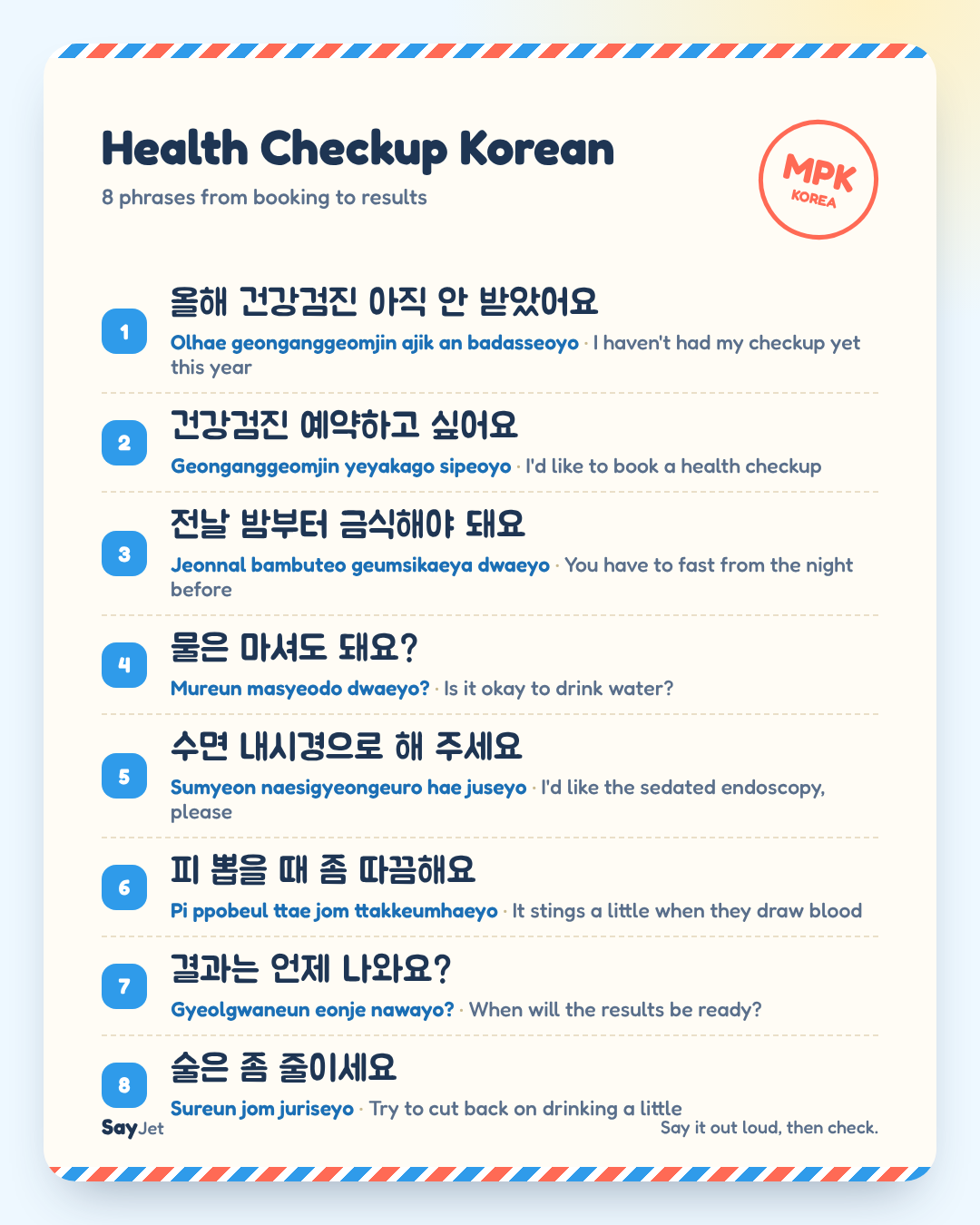
Save the cheat sheet below and read each line out loud once before your appointment.
Quick questions
Will the staff speak English?
It depends on the clinic. Larger hospitals in big cities may have staff who speak English, but forms, directions and name calls during the checkup are usually in Korean — which is why these short sentences help.
What does 수면 mean on the form?
수면 means you'll be sedated for the endoscopy. Clinics usually ask you not to drive for the rest of the day, so plan how you'll get home.
Is the -요 style polite enough at a hospital?
Yes. The -요 endings used in this post are polite and friendly, and they're what most patients use with doctors and nurses.
Practice them with SayJet
SayJet is a speaking-first app we're building. You travel a route across Korea, and each city is a set of short, real sentences you say out loud and get checked on — from the airport in Incheon to your first job in Songdo and a health checkup in Mokpo. No timers, no hearts. Sign up in about 30 seconds — it's free during the beta: app.sayjet.app