Korean at the Doctor: 8 Phrases for Your First Clinic Visit
Published 2026-10-13
Getting sick far from home is stressful enough. The good news: in Korea, seeing a doctor for a cold, a fever or a stomach bug is usually quick. You can often walk into a small neighborhood clinic (의원, uiwon) without an appointment, see a doctor and walk out with a prescription.
What you need is a handful of short sentences: one to check in, a few to say what's wrong and one to understand your medicine. Here they are, with romanization (Korean written in English letters) and a tip on how each one sounds.
The 8 phrases at a glance
| # | Korean | Say it like | Meaning |
|---|---|---|---|
| 1 | 진료받으러 왔어요 | Jillyobadeureo wasseoyo | I'm here to see a doctor |
| 2 | 여기 처음 왔어요 | Yeogi cheoeum wasseoyo | It's my first time here |
| 3 | 건강보험 돼요? | Geongangboheom dwaeyo? | Do you take national health insurance? |
| 4 | 어제부터 열이 나요 | Eojebuteo yeori nayo | I've had a fever since yesterday |
| 5 | 머리가 아파요 | Meoriga apayo | I have a headache |
| 6 | 기침이 계속 나요 | Gichimi gyesok nayo | I keep coughing |
| 7 | 알레르기가 있어요 | Allereugiga isseoyo | I have allergies |
| 8 | 하루에 몇 번 먹어요? | Harue myeot beon meogeoyo? | How many times a day do I take it? |
At the front desk
1. 진료받으러 왔어요 — Jillyobadeureo wasseoyo — I'm here to see a doctor
Jillyo means a doctor's examination, and ___(으)러 왔어요 means "I came to ___." Say it at reception and the staff will know exactly what you need.
Sound tip: it's written 진료 (jin-ryo) but said jil-lyo. When ㄴ (n) comes right before ㄹ (r), the ㄴ turns into ㄹ, so you hear a double "l".
2. 여기 처음 왔어요 — Yeogi cheoeum wasseoyo — It's my first time here
First-time patients usually fill in a short form and show ID. Saying this up front saves a round of questions. Keep your passport or residence card in your pocket.
3. 건강보험 돼요? — Geongangboheom dwaeyo? — Do you take national health insurance?
If you live in Korea long-term, you are probably enrolled in National Health Insurance, and clinics will check it with your ID. ___ 돼요? ("Does ___ work here?") is a handy all-purpose question: Kadeu dwaeyo? — "Can I pay by card?"
Sound tip: dwae is one quick syllable — glide from "w" straight into the "e" of bed.
Telling the doctor what's wrong
4. 어제부터 열이 나요 — Eojebuteo yeori nayo — I've had a fever since yesterday
Doctors almost always ask when it started. ___부터 means "since ___": achimbuteo (since this morning), saheul jeonbuteo (for three days now).
Sound tip: 열이 is spoken as one word, yeo-ri. The ㄹ (l) slides into the next vowel and turns into a light, flapped "r".
5. 머리가 아파요 — Meoriga apayo — I have a headache
This is the most useful pattern in the clinic: (body part)이/가 아파요 — "My ___ hurts." Swap in the body part:
- 배가 아파요 — Baega apayo — My stomach hurts
- 목이 아파요 — Mogi apayo — My throat hurts
- 허리가 아파요 — Heoriga apayo — My lower back hurts
Sound tip: put a strong puff of air on the "p" in apayo. Without the air (and with tight lips), it can sound like 아빠요 (appayo) — "It's Dad."
6. 기침이 계속 나요 — Gichimi gyesok nayo — I keep coughing
Gyesok means "continuously" — it tells the doctor this isn't new. The verb 나요 (nayo, "it comes out") works for fever, coughs and runny noses: Konmuri nayo — "I have a runny nose."
7. 알레르기가 있어요 — Allereugiga isseoyo — I have allergies
Say this before you get any medicine. To be specific, add what you're allergic to: Penisillin allereugiga isseoyo — "I'm allergic to penicillin."
Sound tip: the Korean word has four even beats — al-le-reu-gi — with no stress on any of them. The "eu" is a short sound with your lips spread flat.
Getting your medicine
8. 하루에 몇 번 먹어요? — Harue myeot beon meogeoyo? — How many times a day do I take it?
In Korea, clinics usually give you a prescription and you pick up the medicine at a pharmacy (약국, yakguk) nearby — often in the same building. Pills are often packed by dose in small packets. In Korean you "eat" medicine (meogeoyo), so this question works for the doctor and the pharmacist alike.
Sound tip: 몇 번 is spoken myeot ppeon. The final "t" of myeot makes the next "b" tense and sharp.
Bonus: a note for work or school
Need proof you saw a doctor? Ask 진단서 받을 수 있어요? (Jindanseo badeul su isseoyo?) — "Can I get a medical certificate?" There's usually a small fee, since insurance doesn't cover it. If you only need proof that you visited, ask for a 진료확인서 (jillyo hwaginseo) — it's often enough for work or school.
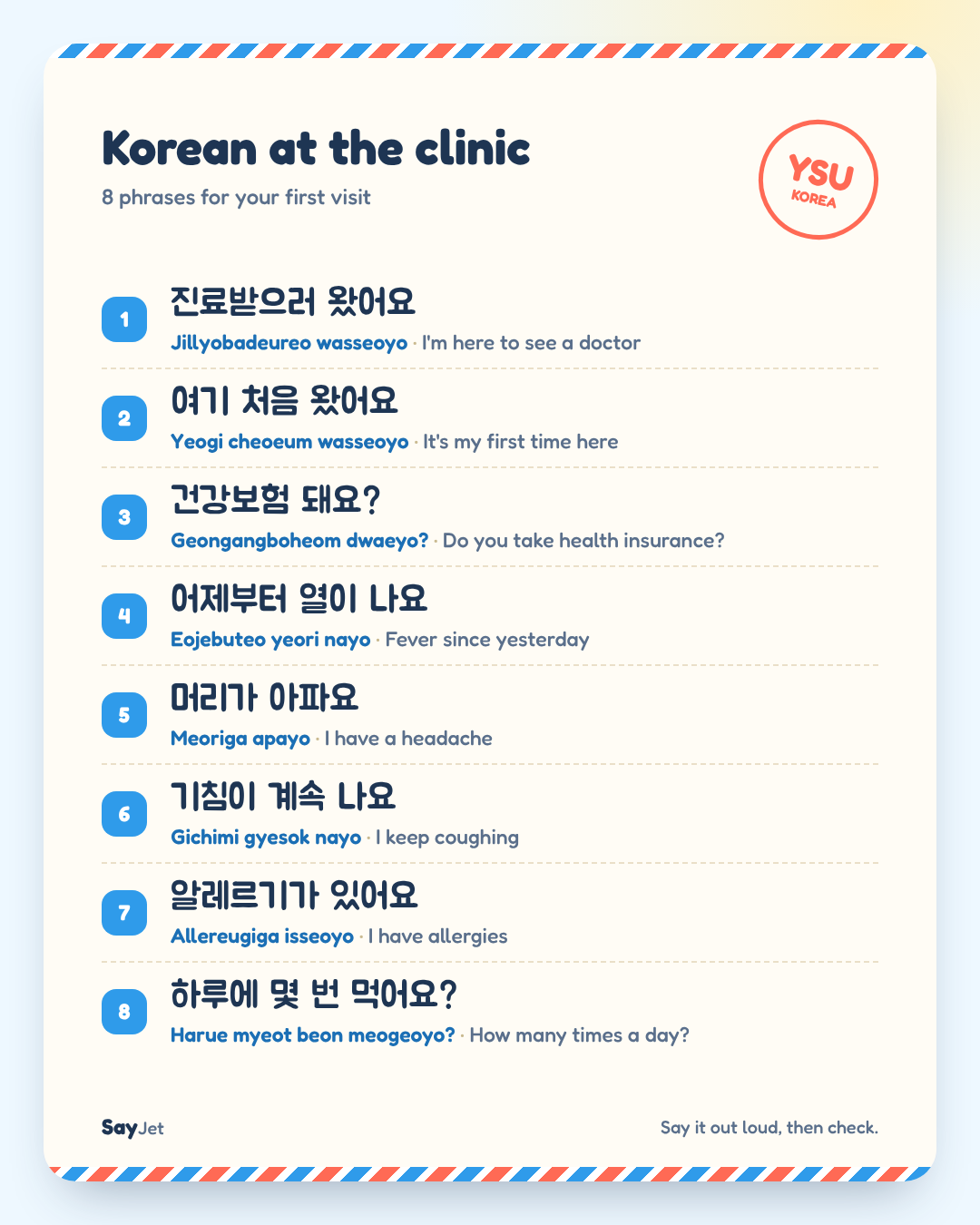
Save the cheat sheet below and read each line out loud once — you won't want to learn them for the first time when you have a fever.
Quick questions
Do I need an appointment?
Small neighborhood clinics usually take walk-ins — you register at the desk and wait your turn. Large university hospitals usually need a referral from a clinic for your insurance to apply. In an emergency, call 119.
What if I don't understand the doctor?
Ask 다시 한번 말씀해 주시겠어요? (Dasi hanbeon malsseumhae jusigesseoyo?) — "Could you say that again, please?" Or show a translation app. Short, clear Korean from you often gets slower, simpler Korean back.
Should I use 아파요 for any pain?
Yes. Apayo covers headaches, sore throats, stomachaches and more. Name the body part, then add apayo.
Practice them with SayJet
SayJet is a speaking-first app we're building. You travel a route across Korea, and each city is a set of short, real sentences you say out loud and get checked on — from the airport in Incheon to finding a home, opening a bank account and, in Yeosu, seeing a doctor. No timers, no hearts. Sign up in about 30 seconds — it's free during the beta: app.sayjet.app