Korean at the Car Repair Shop: 8 Phrases for Oil Changes, Strange Noises and Flat Tires
Published 2026-11-17
If you drive in Korea, sooner or later you'll pull into a 카센터 (kasenteo, literally "car center") — the small neighborhood repair shop — or a larger 정비소 (jeongbiso, auto repair shop). The good news: a lot of car words in Korean come from English. 엔진 오일, 타이어, 브레이크 — you already know them. The trick is saying them the Korean way, and wrapping them in a short, polite sentence.
Here are eight sentences for a visit to the repair shop, with romanization (Korean written in English letters) and a tip on how each one sounds.
The 8 phrases at a glance
| # | Korean | Say it like | Meaning |
|---|---|---|---|
| 1 | 엔진 오일 좀 갈아 주세요 | Enjin oil jom gara juseyo | Could you change the engine oil, please? |
| 2 | 타이어 공기압도 봐 주세요 | Taieo gonggiapdo bwa juseyo | Please check the tire pressure too |
| 3 | 비용이 얼마나 나와요? | Biyongi eolmana nawayo? | How much will it cost? |
| 4 | 한 시간 뒤에 찾으러 올게요 | Han sigan dwie chajeureo olgeyo | I'll come back for it in an hour |
| 5 | 브레이크에서 이상한 소리가 나요 | Beureikeueseo isanghan soriga nayo | There's a strange noise coming from the brakes |
| 6 | 계기판에 경고등이 켜졌어요 | Gyegipane gyeonggodeungi kyeojyeosseoyo | My dashboard warning light came on |
| 7 | 타이어에 펑크가 났어요 | Taieoe peongkeuga nasseoyo | I've got a flat tire |
| 8 | 이거 보험 처리 돼요? | Igeo boheom cheori dwaeyo? | Will my insurance cover this? |
Routine service
1. 엔진 오일 좀 갈아 주세요 — Enjin oil jom gara juseyo — Could you change the engine oil, please?
갈다 (galda) means "to replace" or "to change" a part, and ___ 좀 ___아/어 주세요 is the everyday "Could you ___, please?" The little word 좀 (jom, "a bit") softens the request. Swap in another part: 와이퍼 좀 갈아 주세요 (Waipeo jom gara juseyo) — "Could you replace the wipers, please?"
Sound tip: 갈아 is spoken ga-ra. The ㄹ at the end of 갈 moves over to the next syllable and becomes a quick flap, like the "tt" in American butter.
2. 타이어 공기압도 봐 주세요 — Taieo gonggiapdo bwa juseyo — Please check the tire pressure too
공기압 (gonggiap) is air pressure, and 도 (do) means "too" or "also." 봐 주세요 — literally "please look" — is how Koreans ask someone to check something.
Sound tip: 공기압도 is spoken gong-gi-ap-tto. After the ㅂ at the end of 압, the ㄷ of 도 turns tense: a hard "tt" with no puff of air.
3. 비용이 얼마나 나와요? — Biyongi eolmana nawayo? — How much will it cost?
얼마나 나와요? literally asks "How much will come out?" — it's the natural way to ask for an estimate on a repair or a bill. 얼마예요? (Eolmayeyo?) works for a fixed price; 얼마나 나와요? fits when the total isn't known yet.
Sound tip: 얼마나 is spoken eol-ma-na. Hold the "l" of 얼 for a moment before the "m" — don't drop it or turn it into an "r."
4. 한 시간 뒤에 찾으러 올게요 — Han sigan dwie chajeureo olgeyo — I'll come back for it in an hour
찾다 (chatda) means "to find," but it's also the word for picking up something you left: a car, dry cleaning, a package. ___(으)러 오다 means "to come in order to ___." The -ㄹ게요 (-lgeyo) ending is a friendly promise: "I'll ___."
Sound tip: 찾으러 is spoken cha-jeu-reo. The ㅈ at the bottom of 찾 slides into the next syllable, so you hear a soft "j" in the middle, not a "t."
When something's wrong
5. 브레이크에서 이상한 소리가 나요 — Beureikeueseo isanghan soriga nayo — There's a strange noise coming from the brakes
___에서 소리가 나요 — "a sound comes out of ___" — is how you report any noise: 엔진에서 소리가 나요 (Enjineseo soriga nayo) — "The engine is making a noise." Mechanics will often ask 언제 소리가 나요? (Eonje soriga nayo?) — "When does it make the noise?"
Sound tip: English brake is one syllable, but Korean adds a short 으 to consonants that English runs together: 브레이크 is beu-re-i-keu, four even beats. The 으 (eu) is short, with lips spread, not rounded.
6. 계기판에 경고등이 켜졌어요 — Gyegipane gyeonggodeungi kyeojyeosseoyo — My dashboard warning light came on
계기판 (gyegipan) is the dashboard instrument panel, and 경고등 (gyeonggodeung) is a warning light. 켜지다 (kyeojida) means "to come on" (a light, a screen). Point at it and say this — the mechanic will take it from there.
Sound tip: Don't mix up 켜졌어요 ("it came on") and 커졌어요 ("it got bigger"). Only the first syllable differs: in 켜, start with a quick "y" glide (kyeo); in 커, there's no "y" at all (keo). The rest sounds the same either way — 졌 after ㅈ is said like 저 (jeo). In everyday speech you'll also hear 경고등이 들어왔어요 (Gyeonggodeungi deureowasseoyo).
7. 타이어에 펑크가 났어요 — Taieoe peongkeuga nasseoyo — I've got a flat tire
펑크 (peongkeu) comes from English puncture, and in Korean a flat tire "happens": 펑크가 나다. Many Korean car insurance policies include roadside help (긴급출동, gingeup chuldong) for things like this — check your policy for the phone number before you need it.
Sound tip: 펑크 (peong-keu, flat tire) and 핑크 (ping-keu, pink) differ only in the vowel. For 펑, open your mouth for a relaxed "uh"; for 핑, spread your lips for a clear "ee."
8. 이거 보험 처리 돼요? — Igeo boheom cheori dwaeyo? — Will my insurance cover this?
보험 처리 (boheom cheori) means "handling it through insurance," and 돼요? asks "Can it be done?" It's the question to ask before agreeing to a bigger repair.
Sound tip: In everyday speech, the ㅎ in the middle of 보험 is very soft, so it can sound almost like bo-eom. Saying a light "h" is fine too.
Bonus: the proverb about noise
Korean has a proverb that fits a rattling car: 빈 수레가 요란하다 (Bin surega yoranhada) — "An empty cart rattles the loudest." It's said about people who know the least and talk the most. It's about noise, just like phrase 5's pattern ___에서 소리가 나요:
에어컨에서 이상한 소리가 나요 (Eeokeoneseo isanghan soriga nayo) — "The air conditioner is making a strange noise." The same pattern works for a car, a fridge or the apartment upstairs.
And while the car is in the shop: 차 맡기고 근처에서 기다릴게요 (Cha matgigo geuncheoeseo gidarilgeyo) — "I'll leave the car here and wait nearby." If you're in Ulsan in the fall, the reward after the repair is a drive to 간월재 (Ganwoljae), a mountain pass known for its fields of silver grass (억새, eoksae). Locals will tell you: 산 위는 추우니까 겉옷 챙기세요 (San wineun chuunikka geodot chaenggiseyo) — "It's cold up on the mountain, so bring a jacket."
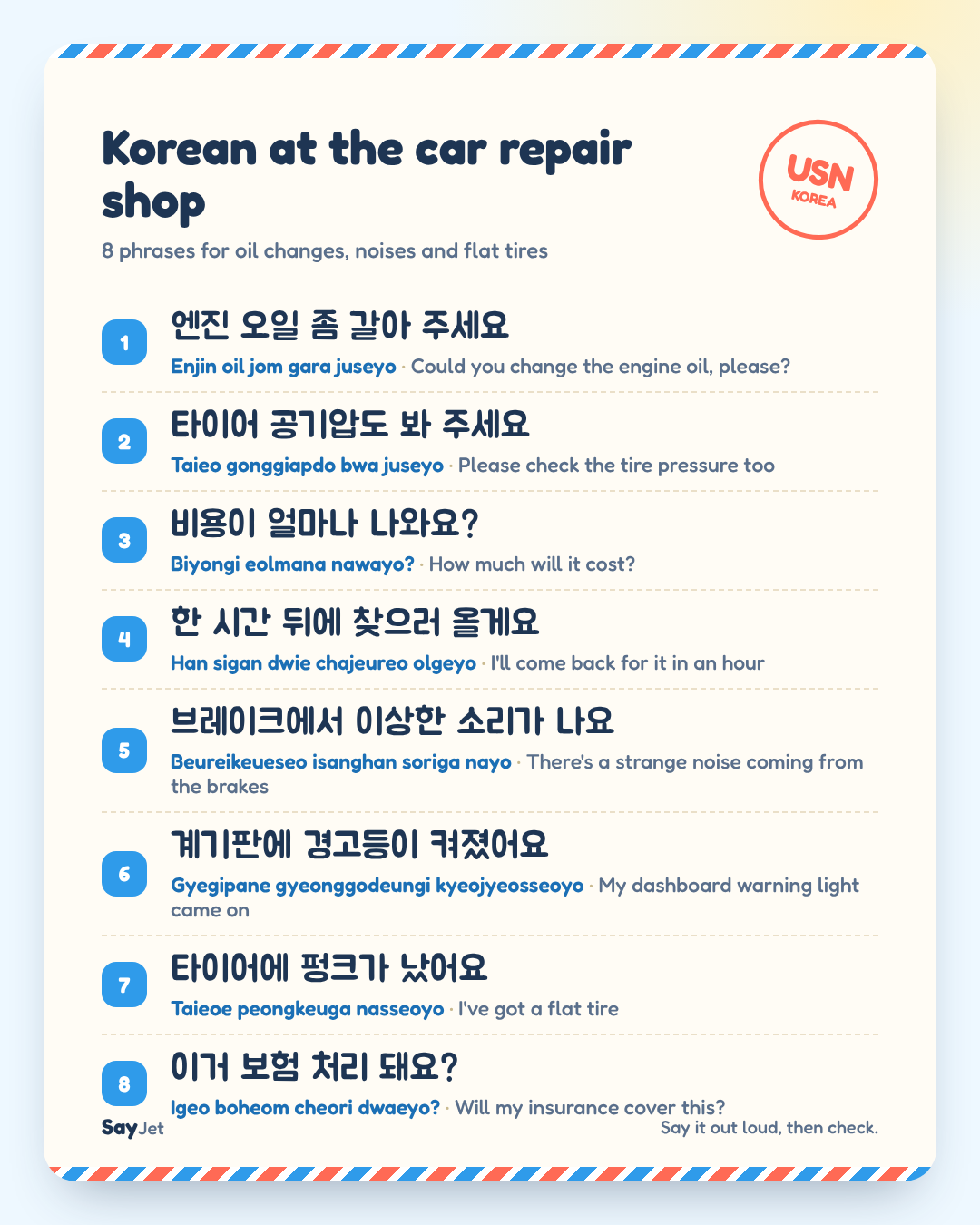
Save the cheat sheet below and say each line out loud once before your next trip to the shop.
Quick questions
Will the mechanic speak English?
Some might, but at a small neighborhood shop you can't count on it. The car words are mostly English loanwords, though, so a short Korean sentence plus pointing goes a long way.
Is 카센터 the same as 정비소?
Close enough for everyday use. 카센터 usually means a small local shop for oil, tires and general repairs; 정비소 is the general word for an auto repair shop, including bigger ones.
Should I ask for the price first?
It's a good habit. 비용이 얼마나 나와요? before the work starts is normal and polite, and you can add 견적 좀 내 주세요 (Gyeonjeok jom nae juseyo) — "Could I get an estimate?"
Practice them with SayJet
SayJet is a speaking-first app we're building. You travel a route across Korea, and each city is a set of short, real sentences you say out loud and get checked on — from the airport in Incheon to your first job in Songdo and a fall trip to the repair shop in Ulsan. No timers, no hearts. Try the first city without signing up; sign up in about 30 seconds to save your progress — it's free during the beta: app.sayjet.app