Korean at the Bank: 8 Phrases for Opening an Account in Korea
Published 2026-10-20
Opening a bank account is one of the first chores of a new life in Korea. You need one for your salary, your rent and your phone bill, and the paperwork usually happens face to face at a branch.
Staff at big branches may speak some English, but a few short Korean sentences make the visit faster and much less stressful. Here are eight, with romanization (Korean written in English letters) and a tip on how each one sounds.
The 8 phrases at a glance
| # | Korean | Say it like | Meaning |
|---|---|---|---|
| 1 | 번호표 뽑아야 돼요? | Beonhopyo ppobaya dwaeyo? | Do I need to take a number? |
| 2 | 계좌 만들러 왔어요 | Gyejwa mandeulleo wasseoyo | I'm here to open an account |
| 3 | 신분증 여기 있어요 | Sinbunjeung yeogi isseoyo | Here's my ID |
| 4 | 외국인도 만들 수 있어요? | Oegugindo mandeul su isseoyo? | Can foreigners open one too? |
| 5 | 체크카드도 만들어 주세요 | Chekeukadeudo mandeureo juseyo | I'd like a debit card too |
| 6 | 해외 송금 돼요? | Haeoe songgeum dwaeyo? | Can I send money abroad? |
| 7 | 수수료가 얼마예요? | Susuryoga eolmayeyo? | How much is the fee? |
| 8 | 카드 재발급해 주세요 | Kadeu jaebalgeupae juseyo | I need my card reissued |
Walking in
1. 번호표 뽑아야 돼요? — Beonhopyo ppobaya dwaeyo? — Do I need to take a number?
Most Korean branches have a ticket machine near the door. You take a number (번호표, beonhopyo), sit down and wait for it to show up on the screen above a counter. Ask this if you can't find the machine or aren't sure which button to press.
Sound tip: 번호표 often sounds like beo-no-pyo. Between an "n" and a vowel, the ㅎ (h) gets very weak, so the "n" slides right into the next syllable.
2. 계좌 만들러 왔어요 — Gyejwa mandeulleo wasseoyo — I'm here to open an account
Gyejwa is a bank account, and ___(으)러 왔어요 means "I came to ___." It's the same pattern you'd use at a clinic or a phone shop, so it's worth learning once and reusing everywhere.
Sound tip: 만들러 has a double "l": man-deul-leo. Hold the tongue tip against the ridge behind your teeth for a beat before leo.
3. 신분증 여기 있어요 — Sinbunjeung yeogi isseoyo — Here's my ID
Hand over your ID with this. For most foreign residents, the bank will usually ask for your residence card, and often your passport too — bring both to be safe, plus anything the bank asks for, such as proof of your job or school.
Sound tip: 있어요 is spoken i-sseo-yo. The final ㅆ (ss) of 있 moves to the next syllable, and it stays sharp and tense.
4. 외국인도 만들 수 있어요? — Oegugindo mandeul su isseoyo? — Can foreigners open one too?
___도 means "___ too," and ___(으)ㄹ 수 있어요? asks "Can I ___?" Rules differ from bank to bank and branch to branch, so asking early can save you a wasted trip.
Getting set up
5. 체크카드도 만들어 주세요 — Chekeukadeudo mandeureo juseyo — I'd like a debit card too
In Korea a debit card is a 체크카드 (chekeukadeu, "check card"). It's handy for daily spending because it takes money straight from your account. While you set it up, staff will often say 비밀번호를 눌러 주세요 (Bimilbeonhoreul nulleo juseyo) — "Please enter your PIN" — and turn a small keypad toward you.
Sound tip: 만들어 is spoken man-deu-reo. The ㄹ (l) slides into the next vowel and turns into a light, flapped "r", almost like the "dd" in American ladder.
6. 해외 송금 돼요? — Haeoe songgeum dwaeyo? — Can I send money abroad?
___ 돼요? ("Does ___ work here?" or "Can I ___?") is one of the most useful short questions in Korean. Swap in what you need: Kadeu dwaeyo? — "Can I pay by card?"
Sound tip: dwae is one quick syllable — glide from "w" straight into the "e" of bed.
7. 수수료가 얼마예요? — Susuryoga eolmayeyo? — How much is the fee?
Fees can apply to sending money abroad, to some ATM withdrawals and to reissuing a card. ___이/가 얼마예요? — "How much is ___?" — works in any shop, too.
When something goes wrong
8. 카드 재발급해 주세요 — Kadeu jaebalgeupae juseyo — I need my card reissued
Lost your card, or it stopped working? Jae- means "again" and balgeup means "issuing." Bring your ID, since the bank will need to check who you are again.
Sound tip: 재발급해 is spoken jae-bal-geu-pae. When ㅂ (b) meets ㅎ (h), they merge into one strong "p" with a puff of air.
Bonus: checking your balance
At the counter, ask 잔액 좀 확인해 주세요 (Janaek jom hwaginhae juseyo) — "Could you check my balance?" At an ATM, look for 잔액 조회 (janaek johoe, "balance inquiry"). And if you can't find an ATM, ask 현금 인출기 어디 있어요? (Hyeongeum inchulgi eodi isseoyo?) — "Where's the ATM?"
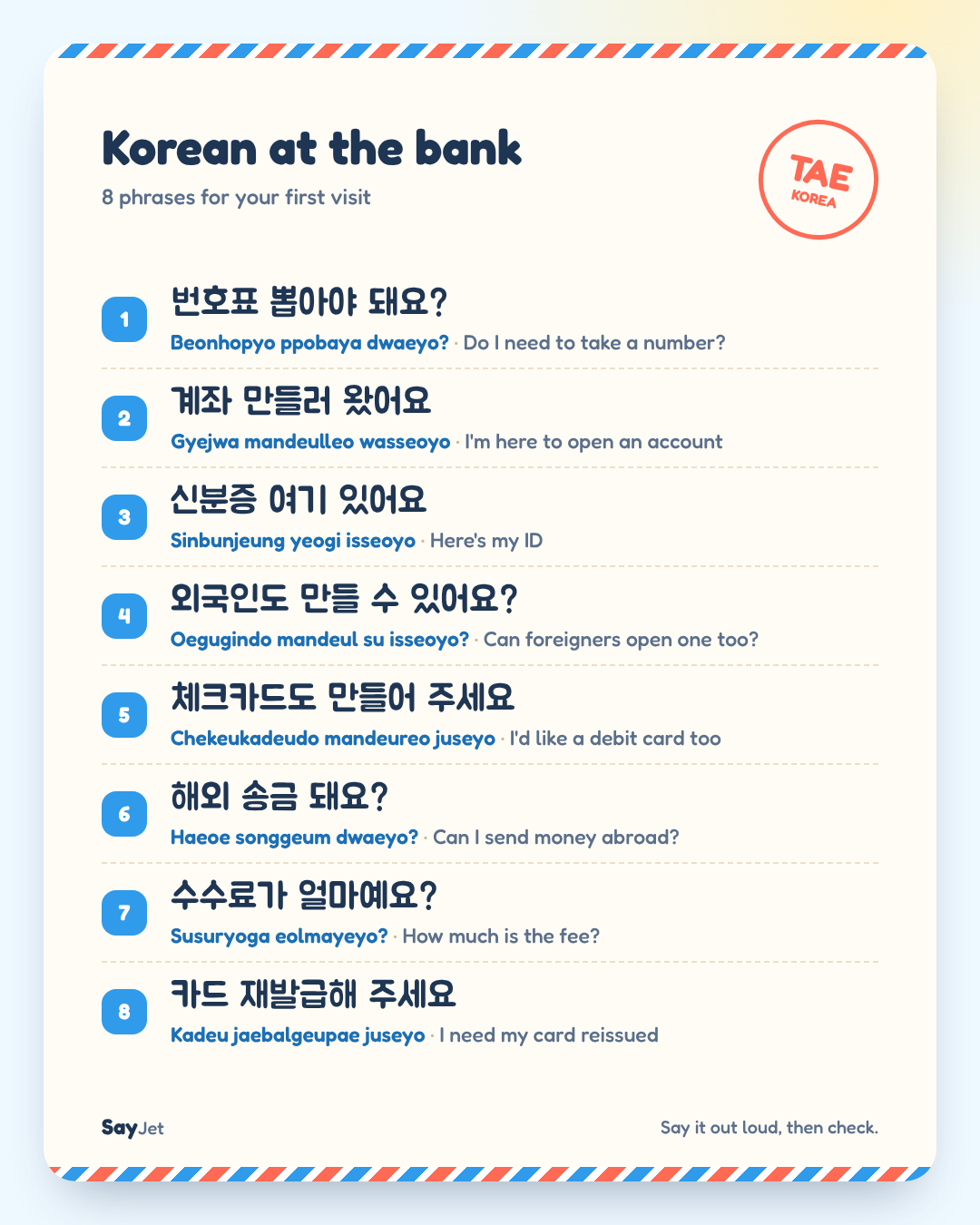
Save the cheat sheet below and read each line out loud once before you go.
Quick questions
What should I bring to open an account?
Usually your ID — for most foreign residents that means the residence card — plus whatever extra papers that bank asks for. Requirements change and differ by bank, so check with your branch before you go.
Can I do all of this in English?
Sometimes. Some branches in big cities have English-speaking staff or a foreigner desk, and many banks have English pages in their apps. Still, short Korean sentences help a lot when the person at the counter doesn't speak English.
What's the difference between 계좌 and 통장?
계좌 (gyejwa) is the account itself. 통장 (tongjang) is the bankbook — a small paper booklet some banks still give you with a new account. In everyday speech, people often use 통장 to mean the account, too.
Practice them with SayJet
SayJet is a speaking-first app we're building. You travel a route across Korea, and each city is a set of short, real sentences you say out loud and get checked on — from the airport in Incheon to finding a home and, in Daegu, opening a bank account. No timers, no hearts. Sign up in about 30 seconds — it's free during the beta: app.sayjet.app