Korean at Work: 8 Phrases for Your First Weeks at a Korean Office
Published 2026-10-27
Starting a job in Korea means a lot of new faces in a short time: your team, the people at the next desk, clients at a trade fair. Many offices use some English, but the small talk around the work — saying hello, swapping business cards, wrapping up the day — usually happens in Korean.
Here are eight short sentences that come up again and again in a Korean office, with romanization (Korean written in English letters) and a tip on how each one sounds.
The 8 phrases at a glance
| # | Korean | Say it like | Meaning |
|---|---|---|---|
| 1 | 오늘부터 여기서 일하게 됐어요 | Oneulbuteo yeogiseo ilhage dwaesseoyo | I'm starting work here today |
| 2 | 명함 드릴게요 | Myeongham deurilgeyo | Here's my business card |
| 3 | 회의실 예약은 어떻게 해요? | Hoeuisil yeyageun eotteoke haeyo? | How do I book a meeting room? |
| 4 | 회의 자료 메일로 보냈어요 | Hoeui jaryo meillo bonaesseoyo | I sent the meeting materials by email |
| 5 | 견적서는 메일로 보내 드릴게요 | Gyeonjeokseoneun meillo bonae deurilgeyo | I'll email you the quote |
| 6 | 다음 달부터 같이 일하기로 했어요 | Daeum dalbuteo gachi ilhagiro haesseoyo | We've agreed to start working together next month |
| 7 | 오늘 저녁에 팀 회식이 있어요 | Oneul jeonyeoge tim hoesigi isseoyo | We have a team dinner tonight |
| 8 | 오늘 하루 수고 많으셨어요 | Oneul haru sugo maneusyeosseoyo | Thanks for all your hard work today |
Your first day
1. 오늘부터 여기서 일하게 됐어요 — Oneulbuteo yeogiseo ilhage dwaesseoyo — I'm starting work here today
___게 됐어요 means "it has turned out that I ___" — a soft, humble way to talk about a change in your life. Add your name, and you have a complete first-day greeting: 저는 ___이에요/예요 (Jeoneun ___-ieyo/-yeyo, "I'm ___"). Use 이에요 after a consonant and 예요 after a vowel.
Sound tip: 일하게 sounds like i-ra-ge. After ㄹ (l), the ㅎ (h) almost disappears, and the "l" flips into a light "r".
2. 명함 드릴게요 — Myeongham deurilgeyo — Here's my business card
Business cards still matter in Korea, especially with clients. Hand yours over with both hands, the text facing the other person, and take theirs the same way. Look at it for a moment before you put it away.
Sound tip: 드릴게요 is spoken deu-ril-kke-yo. In this ending, the ㄱ (g) after ㄹ turns tense, like a hard "kk" with no puff of air.
3. 회의실 예약은 어떻게 해요? — Hoeuisil yeyageun eotteoke haeyo? — How do I book a meeting room?
___은/는 어떻게 해요? — "How do I ___?" — is the question you'll ask most in your first week. Swap in anything: Hyuga sincheongeun eotteoke haeyo? — "How do I request time off?"
Sound tip: 어떻게 is spoken eo-tteo-ke. The ㅎ (h) and ㄱ (g) merge into one strong "k" with a puff of air.
Meetings and clients
4. 회의 자료 메일로 보냈어요 — Hoeui jaryo meillo bonaesseoyo — I sent the meeting materials by email
Jaryo covers any kind of materials: slides, reports, handouts. ___(으)로 means "by" or "with," so meillo is "by email."
Sound tip: 메일로 has a double "l": me-il-lo. Keep the tongue tip on the ridge behind your teeth through both.
5. 견적서는 메일로 보내 드릴게요 — Gyeonjeokseoneun meillo bonae deurilgeyo — I'll email you the quote
___아/어 드릴게요 means "I'll ___ for you," said politely to a client or someone senior. With a coworker at your level, the less formal ___아/어 줄게요 works: Bonae julgeyo — "I'll send it to you." With a close friend, drop the 요: Bonae julge.
Sound tip: 견적서 is spoken gyeon-jeok-sseo. After the ㄱ (k), the next ㅅ (s) turns tense — a sharp "ss".
6. 다음 달부터 같이 일하기로 했어요 — Daeum dalbuteo gachi ilhagiro haesseoyo — We've agreed to start working together next month
___기로 했어요 means "we decided to ___" or "we agreed to ___" — perfect for sharing the result of a meeting. Koreans have a proverb for a deal that's good for everyone: 누이 좋고 매부 좋고 (Nui joko maebu joko), "good for the sister and good for her husband."
Sound tip: 같이 is spoken ga-chi, not gat-i. When ㅌ (t) meets the vowel 이, it changes into "ch".
After work
7. 오늘 저녁에 팀 회식이 있어요 — Oneul jeonyeoge tim hoesigi isseoyo — We have a team dinner tonight
A 회식 (hoesik) is a dinner with your team after work, often to welcome a new member or celebrate the end of a project. If you need to leave before the second round, a simple 오늘은 먼저 갈게요 (Oneureun meonjeo galgeyo) — "I'll head out first today" — does the job. With your team leader, the more formal 먼저 들어가 보겠습니다 (Meonjeo deureoga bogetseumnida) is safer.
Sound tip: 회식이 is spoken hoe-si-gi. The final ㄱ (k) of 식 slides into the next vowel and turns soft: "g".
8. 오늘 하루 수고 많으셨어요 — Oneul haru sugo maneusyeosseoyo — Thanks for all your hard work today
You'll hear this at the end of the day, after a long meeting or when a project wraps up. It thanks people for their effort, not for a favor. With someone much more senior, a simple 감사합니다 (Gamsahamnida) is always safe.
Sound tip: In 많으셨어요 (ma-neu-syeo-sseo-yo), the ㅎ in 많 is silent. In standard pronunciation, there's no "h" here.
Bonus: going on a business trip
Heading out of town for work? 내일 부산으로 출장 가요 (Naeil Busaneuro chuljang gayo) means "I'm going on a business trip to Busan tomorrow." Chuljang is a business trip, and you can swap in any city. When you get back: 출장 보고서는 월요일까지 낼게요 (Chuljang bogoseoneun woryoilkkaji naelgeyo) — "I'll hand in my trip report by Monday."
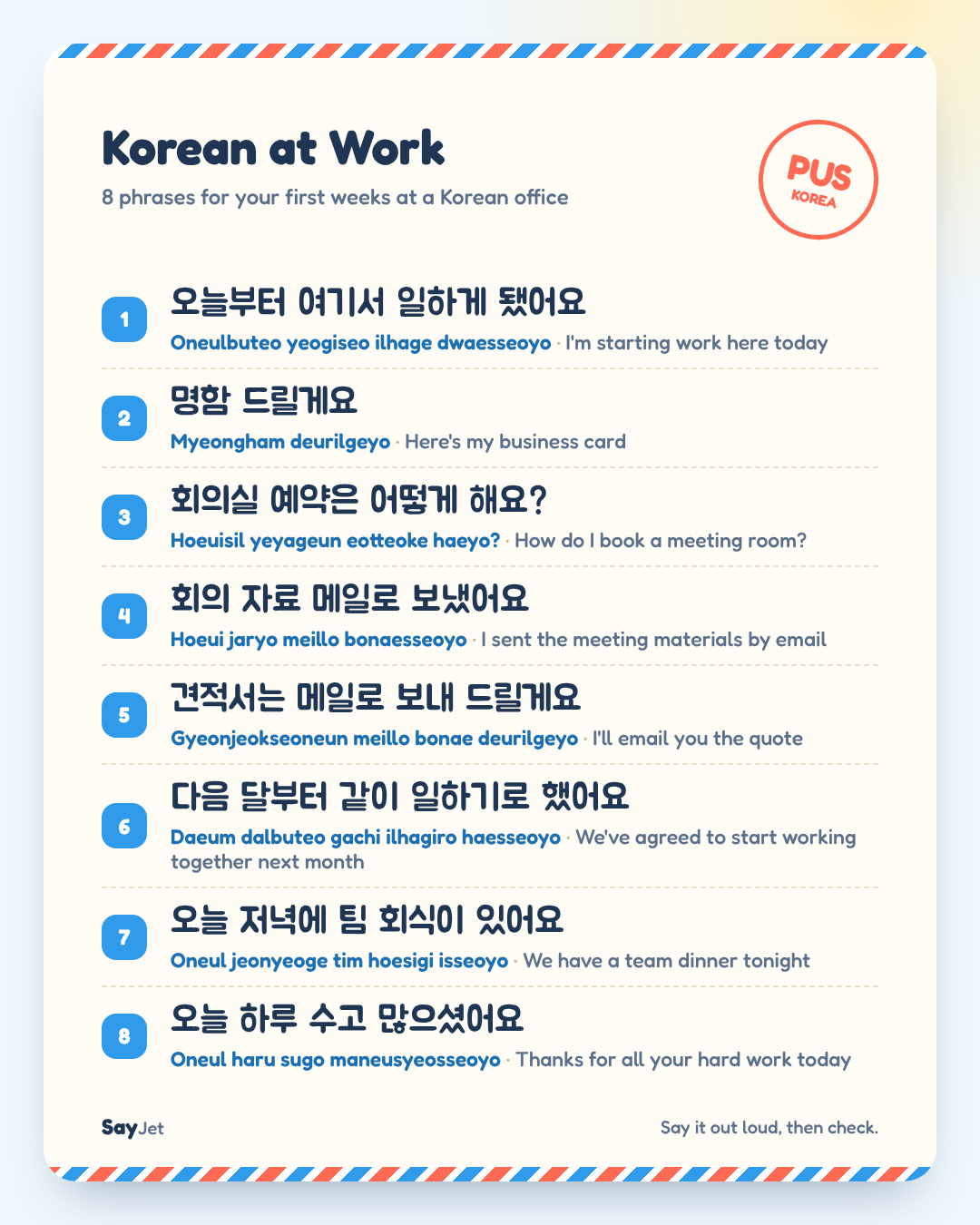
Save the cheat sheet below and read each line out loud once before your first day.
Quick questions
Should I use 해요 or 합니다 at work?
Both are polite. The -요 endings (haeyo) used in this post are friendly and polite, and they're what most coworkers use with each other every day. The -ㅂ니다 endings (hamnida) are more formal and show up in presentations, announcements and with very senior people.
Do I have to go to every team dinner?
Not always. It depends on the team, but most people understand if you leave early or skip one now and then. Showing up to the first welcome dinner is a nice way to meet everyone.
What do I call my coworkers?
Usually by name plus 님 (-nim) or by job title, such as 팀장님 (timjangnim, team leader). If you're not sure, listen to what others say, or simply ask: Eotteoke bulleo deurilkkayo? — "How should I address you?"
Practice them with SayJet
SayJet is a speaking-first app we're building. You travel a route across Korea, and each city is a set of short, real sentences you say out loud and get checked on — from the airport in Incheon to your first day at work in Songdo and a business trip to Busan. No timers, no hearts. Sign up in about 30 seconds — it's free during the beta: app.sayjet.app